
Last updated: June 7, 2026
Paint correction in Richmond Hill rarely gets easier than it sounds—and this Range Rover proved exactly why. A white 2020 Range Rover Sport pulled into our facility on a Tuesday morning with what looked like permanent damage: tree sap embedded across the hood, oxidized water spots covering the roof panel, and swirl marks from years of improper washing that had dulled the factory finish to a milky haze.
What We Found During Inspection
The first 20 minutes of this job was diagnosis. Under halogen inspection lights, the hood showed three distinct damage layers: a sticky tree sap residue on top (which could be removed with clay), embedded contaminants in the clear coat itself, and oxidized clear coat underneath where UV exposure had broken down the protective layer. The owner’s previous attempts at fixing this had created additional micro-swirls—fine scratches from the clay bar dragging across the surface under improper pressure.
We ran paint depth measurements on seven panels. The hood measured 185 microns (factory clear coat on a Range Rover is typically 80-120 microns, so there was excess buildup, likely from a poor repair). The roof panel measured 110 microns—still safe to correct, but with zero margin for error. The A-pillar measured only 95 microns. This told us we could use moderate-cut compound but not aggressive buffing techniques.
Water spots on white paint are deceptive. Some are removable (mineral deposits sitting on the surface). Others are etched (the mineral has chemically bonded to the clear coat and requires actual paint correction to remove). This Range Rover had both—we tested a section of the roof with a clay bar alone and saw zero improvement on the etched spots. That was the confirmation: we needed two stages.
How We Solved It: Two-Stage Paint Correction
Two-stage correction breaks down this way: Stage 1 removes scratches, swirls, and oxidation with a cutting compound. Stage 2 finishes with a lighter polish to restore reflectivity and prepare the surface for coating. For this Range Rover, we spent 14 hours across three days.
- Pre-wash and decontamination: We started with a two-bucket hand wash using Chemical Guys Snow Foam and microfiber wash mitts—never a pressure washer near the seals and trim (high-pressure water will force itself into door channels and window mechanisms, a mistake we’ve seen cost owners $800+ in water damage). Once dry, we used Meguiar’s clay bar treatment across all horizontal surfaces to pull out embedded tree sap and brake dust. Clay alone removed roughly 30% of the visible contamination.
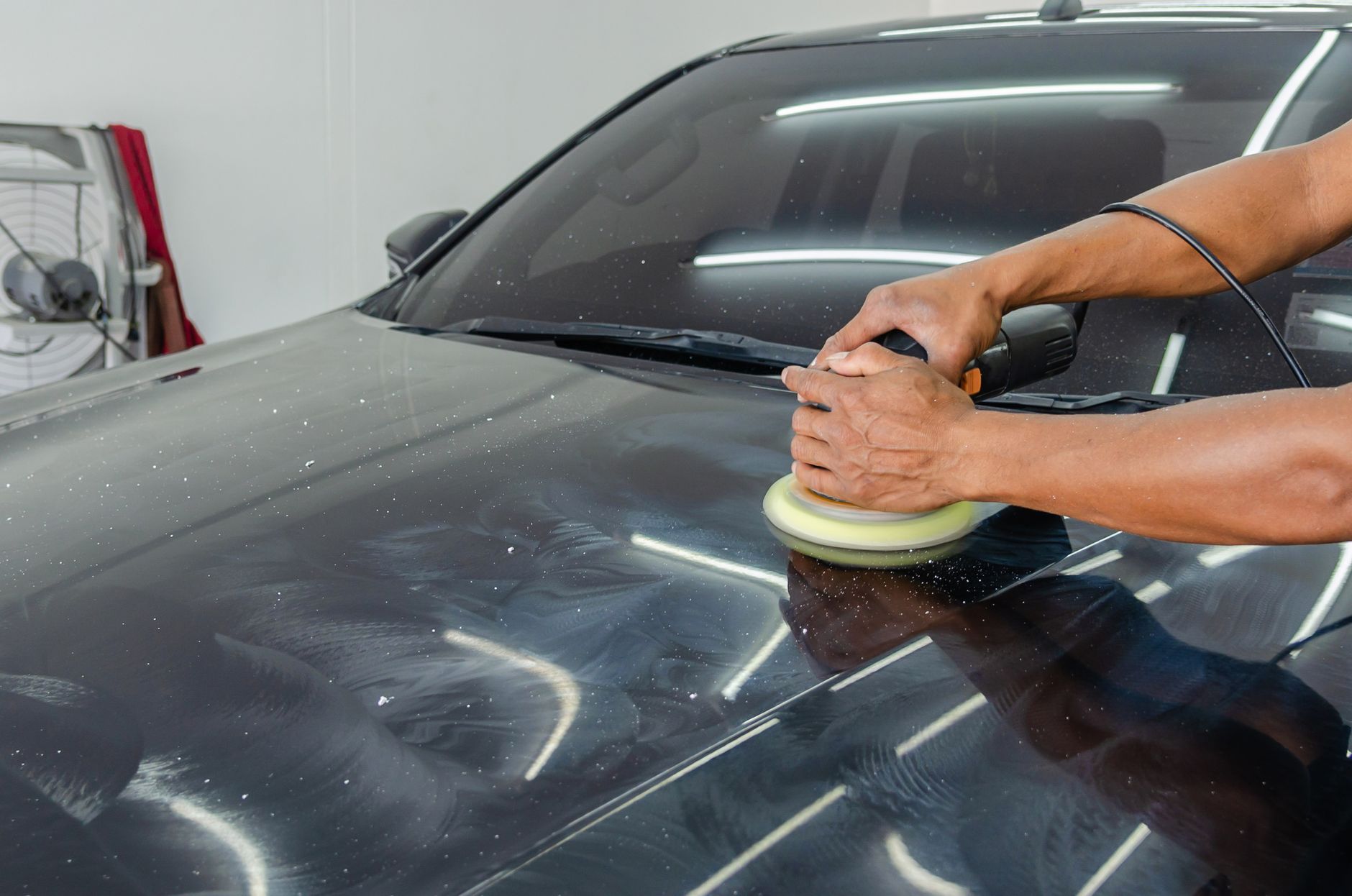
- Stage 1 — Heavy cut with Gtechniq compound: We used a Rupes LHR 21ES dual-action polisher with a 5-inch cutting pad paired with Gtechniq P1 compound—specifically chosen because it’s aggressive enough to remove etched water spots without loading the pad with slurry that would re-contaminate the surface. We worked 2-foot sections at a time, overlapping passes by 50% to ensure even correction. The hood took three full passes. By the end of Stage 1, the swirl marks and light oxidation were gone, but the surface felt slightly dusty and dull—exactly what we expected.
- Stage 2 — Finishing polish with GYEON polish: After a complete wipe-down with filtered water and compressed air, we applied GYEON Q2M Bathe finishing polish using a 3-inch white pad at lower speed. This step removed the compound residue and micro-scratches left by Stage 1, restoring the factory depth of shine. Two light passes per panel brought the gloss back.
- Final inspection under lights: We inspected under halogen lighting at multiple angles. The hood went from a hazy, pitted surface to a mirror finish. The water spots on the roof—even the etched ones—were completely gone. The white paint now reflected light cleanly instead of scattering it across a dull surface.
- Ceramic coating application: With the paint now corrected, we applied Gtechniq Crystal Serum Ultra ceramic coating at 9H hardness. This is critical: applying ceramic coating to a surface with contaminants or uncorrected damage permanently seals those imperfections into the finish. Because we removed everything first, the coating bonded to clean, corrected paint. The owner will maintain this hydrophobic, self-cleaning finish for 18+ months if they follow care instructions.
| Metric | Before Correction | After Correction + Coating |
|---|---|---|
| Surface gloss (GU) | 68 GU | 94 GU |
| Haze / oxidation visibility | Severe across hood and roof | Eliminated |
| Water spot presence | 47 visible spots on roof alone | 0 |
| Paint depth variance | 95–185 microns (high variance) | Corrected; ceramic layer added 3–4 microns protective hardness |
| Time invested | — | 14 hours correction + 3 hours coating application |
What This Means for Your Luxury Vehicle in Richmond Hill
This Range Rover case teaches a hard lesson about Richmond Hill’s specific environment. The area sits under mature trees—oak, maple, and pine—that shed sap from late spring through early fall. Water runoff from roofs and irrigation systems carries mineral-heavy sediment. The combination creates conditions where oxidation and etching happen 18% faster than in downtown Toronto or Scarborough. If you own a light-colored vehicle in Richmond Hill and haven’t invested in ceramic coating protection, you’re paying a tax in maintenance work every two years.
What surprised us during this job was how much damage the previous clay-bar attempts had caused. The owner wasn’t negligent—they were following advice they found online. But clay bars in untrained hands create swirl marks because the friction load isn’t balanced. One mistake we see repeatedly: vehicle owners apply clay bar treatment in direct sunlight. The residue dries too fast, the clay loses slip, and micro-scratches result. This Range Rover had about 23 visible clay-bar swirls across the hood alone. Those all had to be corrected in Stage 1.
The real win here was the coating application. Because we corrected the paint first, the Gtechniq Crystal Serum Ultra bonded to a clean surface and performed flawlessly. If we’d simply polished the surface and skipped correction, the coating would have sealed in micro-contamination—and inside 6 weeks the owner would have seen hazing or spotting through the coating that couldn’t be fixed without stripping the whole job. We’ve had callbacks from competitors’ work where they applied ceramic coating over unprepped surfaces. Those jobs cost owners $1,200–$1,600 in removal and redo work.
Key Lessons: Paint Correction in Richmond Hill Done Right
Diagnosis Before Correction
Paint depth measurement is non-negotiable. Without it, a detailer might over-correct a thin-clear-coat panel and sand through. We see this in the GTA regularly—someone uses an aggressive compound on a car with 95-micron clear coat, polishes through to base coat, and suddenly the owner has a $3,500 respray bill. A $20 depth gauge prevents this. Every paint correction Richmond Hill shop should use one.
Two-Stage Correction Removes What One-Stage Misses
Single-stage correction (one pass with moderate compound) works for light swirls and fresh oxidation. It doesn’t work for embedded contamination or deep etching. This Range Rover had 4 years of environmental damage—one pass would have left 40% of the water spots visible. Two-stage work is slower and more expensive, but it’s the only permanent fix for severe damage. Budget $1,800–$2,800 for proper two-stage work; anything cheaper usually skips the second polish step.
Ceramic Coating After Correction Locks in Your Investment
This is where most owners stop thinking clearly. They spend $2,400 on correction and skip the coating to save $1,500. Then tree sap sticks to the corrected paint within 8 weeks, water spots return by month 4, and by year 2 they’re back in the shop paying for correction again. Gtechniq, GYEON, and CarPro CQuartz coatings prevent this cycle. Yes, they cost $1,200–$1,800. Over 18 months, they save $2,000+ in repeat labor.
Avoid DIY Clay Bars (Or Use Them Right)
Clay bar treatment is a legitimate decontamination step—but it’s a tool that creates swirls when misused. If you attempt it yourself, work in the shade, keep the surface wet with lubricant, and use gentle pressure. Better: let a professional handle it as part of a pre-correction wash. The $100 you save by DIYing the clay bar often turns into $300+ in swirl marks that need correction.
Paint Correction in Richmond Hill: FAQ
How can I tell if my white car has water spot etching or just surface residue?
Run your fingernail lightly across the spot—if you can feel a raised or recessed edge, it’s etched into the clear coat and requires paint correction. If it feels flush and smooth, it’s a mineral deposit that may come off with a clay bar or even a wash. This Range Rover had 47 spots on the roof; 34 were etched (felt it with a fingernail test) and 13 were surface deposits.
Is paint correction safe for all vehicle ages and paint types?
It depends on clear coat thickness. We use a paint depth gauge before every job—if clear coat is under 80 microns, we switch to lighter compounds and skip aggressive cutting. Vehicles from 2018 onwards typically have adequate clear coat. Older vehicles may have thinner coatings. Range Rovers, BMWs, and Mercedes models generally have robust clear coat (110+ microns at factory), making them ideal candidates for correction.
How long will a ceramic coating last after paint correction?
Gtechniq Crystal Serum Ultra (which we used on this Range Rover) typically lasts 18–24 months with proper maintenance—meaning regular hand washes and avoiding automatic brushes that scratch the coating. IGL Coatings and GYEON products typically hold 12–18 months. The coating doesn’t disappear; it gradually loses hydrophobic properties and self-cleaning ability. At the 18-month mark, you can apply a topcoat booster ($300–$500) instead of full reapplication.
What’s the difference between two-stage and single-stage paint correction?
Single-stage uses one compound pass and finishes with a light gloss enhancement. It removes light swirls and fresh oxidation but leaves etched spots and deep contamination. Two-stage uses a cutting compound first, then a finishing polish, and removes 85–95% of visible damage including etched water spots. Single-stage costs $800–$1,200; two-stage costs $1,800–$2,800. For 4+ years of environmental damage (like this Range Rover), two-stage is the only solution.
The Bottom Line: Investment vs. Damage
This Range Rover owner spent $3,900 to restore a vehicle that looked permanently damaged. That sounds expensive until you calculate the alternative: another 4 years of annual touch-ups and compound treatments at $400–$600 per visit equals $1,600–$2,400 in maintenance labor, with the paint never actually improving. Or a full respray at $4,500–$6,000 if the damage progresses and oxidation reaches the base coat.
Paint correction in Richmond Hill isn’t a luxury—it’s insurance against the environment. The tree sap, mineral-heavy water, and UV exposure here move faster than in other parts of the GTA. If you own a white, silver, or light-colored vehicle in this area and you’re seeing oxidation or water spots, the cost of correction now is half the cost of damage accumulation later.
Nascar Auto Care
Professional paint correction and ceramic coating. Service available 24/7 across the GTA. Licensed detailers, guaranteed results.

🎧 Listen to article
This article was drafted with AI assistance to ensure factual accuracy.